
Métis Experimental Farms
Overview
In the 1940s and 1950s, farms were started by the Saskatchewan government and the Roman Catholic Church. These Experimental Farms were created to “rehabilitate” displaced Métis people (including those living on the road allowances). The Métis were not allowed to manage the farm even though many of the people who lived on the road allowances had farming experience. The Métis people on these farms were underpaid and used as cheap labour.
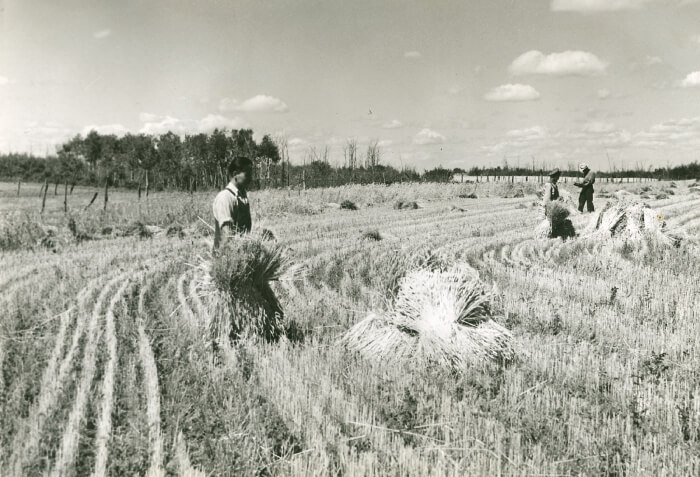
Photo Credit: Provincial Archives of Saskatchewan (R-B12457-31)
Métis men carrying crop sheaves by hand at Lebret, SK farm
Lebret Farm
An example of an experimental farm is the Lebret Farm. The goal was to provide training, employment, and food for people in the Lebret area, specifically the displaced Métis people who were living on the road allowances. All the agricultural land was used to provide feed for livestock. The Lebret experimental farm began operating in the mid 1900s and a variety of Métis families lived and worked there during its years of operation.
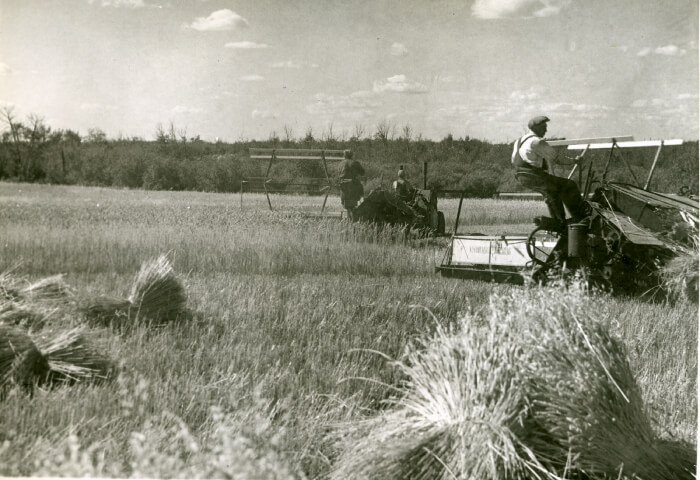
Photo Credit: Provincial Archives of Saskatchewan (R-B12457-22)
Men harvesting at the Lebret Métis farm in 1946
Farm Closures
The Métis people working at these farms got a very low wage and it was extremely hard manual labour. They also had to purchase the food they worked hard to grow and raise. Eventually these underappreciated workers would move to places where they could work for better pay and control their own money, often to cities.
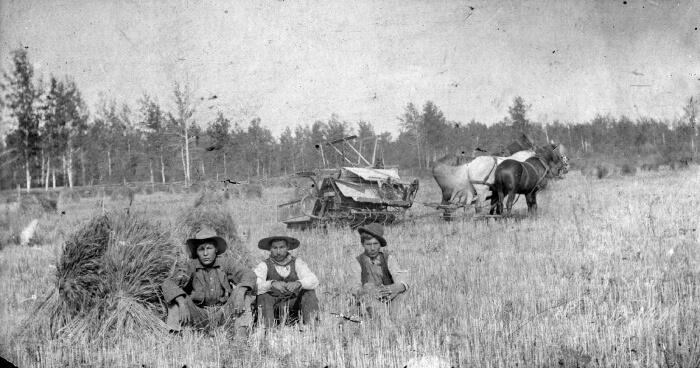
Photo Credit: Provincial Archives of Saskatchewan (S-B9117)
The Métis had to do a lot of work for little to no pay
Ultimately these government-run farms failed because the Métis had no say in how the farms operated, and there were disagreements between the government, the church, and the farm managers. Métis people chose to leave to earn more money elsewhere.